A tribute to Harold Rowling MBE (1922-2023) – Founder of The Monday Group
Harold Rowling was of the wartime generation – he was a real character, capable, self-assured, very much a ‘can-do’ person. He abhorred bureaucracies and ‘pen-pushing’ with a vengeance.
He emerged from the war with a first-class degree in engineering and knowledge and experience of engineering from his RAF service in India. He settled in Westmeston, where he built his own house on a plot in Underhill Lane, and brought up a family of five girls with his wife, Pam. He had courted Pam in the war years while studying in London, thinking nothing of regularly cycling from London to Lewes and back to see her. His trips involved dodging wartime restrictions in a clandestine way that typified his defiance of authority and characterised his independence – including straying into areas littered with ordnance and not accepting MOD ‘Keep Out’ warnings which he took with a pinch of salt.
Following a successful career as a civil engineer he turned his restless spirit to the task of opening up the footpath network around Ditchling and Hassocks, following war time footpath closures and downland exclusions. As told in ‘The Stile Book’, which documents the early years of the Monday Group (available here), in 1961 Pam said to him:
“We should be able to take the dogs walking on the Downs, Harold, but all the ways up are closed off. We can’t go on like this. You’ve got to do something about it.”
Early Beginnings
Thus the germ of the Monday Group was formed. Beginning on his own, laying a path with ready-mix concrete through North End, Westmeston without any assistance. He soon acquired a team of volunteers, and when retirement allowed, it became routine to work on Mondays. Hence the ‘Monday Group’.
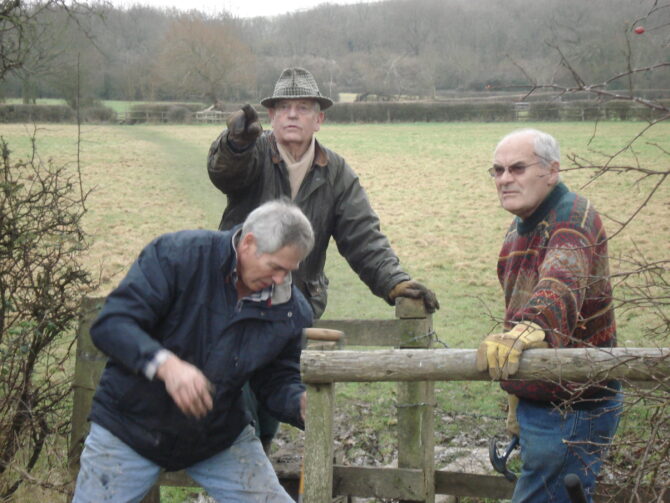
The Monday Group pioneers were a hardy and resourceful group, undaunted by obstacles and challenges. They designed, constructed and installed bridges, stiles and other structures and hacked relentlessly away at scrub and thorny undergrowth to reveal the local rights of way network and ensure its accessibility to all.
True to Harold’s buccaneering approach to life, they were fearless in taking on authority where it stood in their way, and their approach was to act first and worry about technicalities later.
Harold’s Way
Eventually the organisation grew into a number of teams, working more or less as a confederated network. Harold dominated the organisation, deciding key matters in his kitchen, and leading from the front. It was almost a point of pride that there were no committees, minutes, chairman, secretary or treasurer. Although there were occasional wider meetings of volunteers, they were never formalised, and Harold pointedly referred to annual gatherings as ‘not the AGM’.
Harold’s Stiles
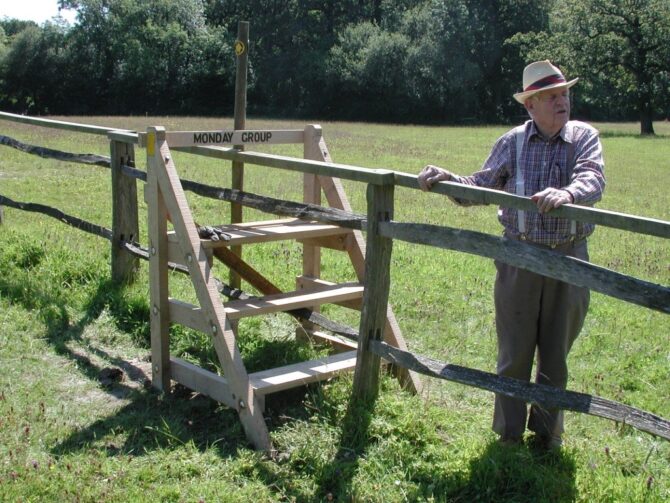
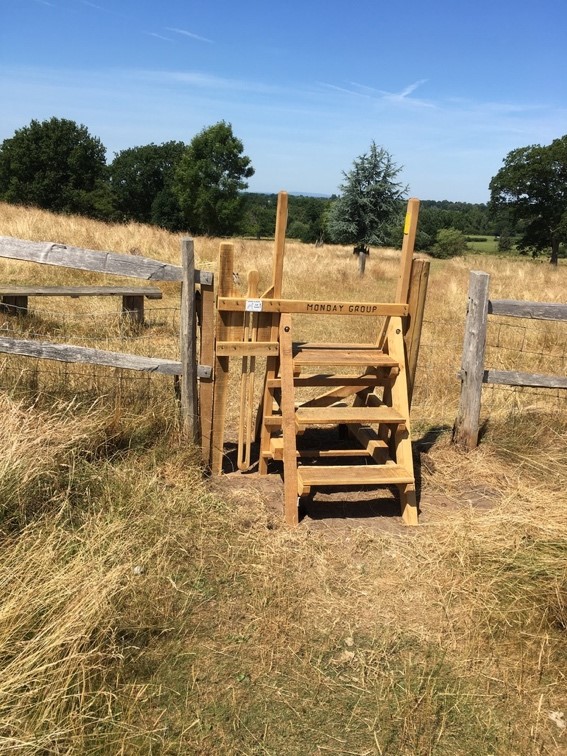
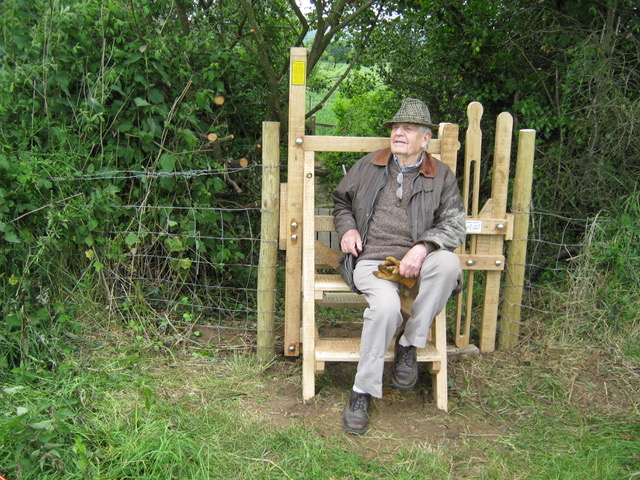
Harold also invested his skills and experience into developing and refining the designs of the structures, particularly stiles. As well as the Monday Group itself, it is perhaps stiles that will be his greatest legacy. The aim was to design stiles that were easy to use, quick to install, and stockproof. He established a tradition of working only in green oak as it was durable, locally sourced (well before environmental sustainability was an issue of popular debate) and integrated aesthetically into the rural landscape. They were universally admired and continue to be so.
Stile design developed steadily, with improvements based on experience, and each iteration was numbered, to the current designs of Mk26 and Mk23. Design details had their devotees, and there was passionate debate about the relative merits of arcane features such as the lifting bar. Harold continued to develop stile design well into his 90s, his holy grail being a design without the need for angled cuts, which could be built by a competent amateur with no woodworking skills.
Stepping Aside
In 2018, aged 96, and with failing eyesight Harold announced his reluctant decision to step aside from a leading role. He set out his preference for a succession based on identifying what he referred to as a ‘capo di tutti capi’ (a Mafia term describing “the head of all heads”). A group of members convened, and in the absence of a single leader in Harold’s mould coming forward, decided, somewhat inevitably and to Harold’s chagrin, that a committee should be formed. Thus, the job that for over 50 years Harold had performed on his own now required 9 members and a lot more paperwork.
Harold
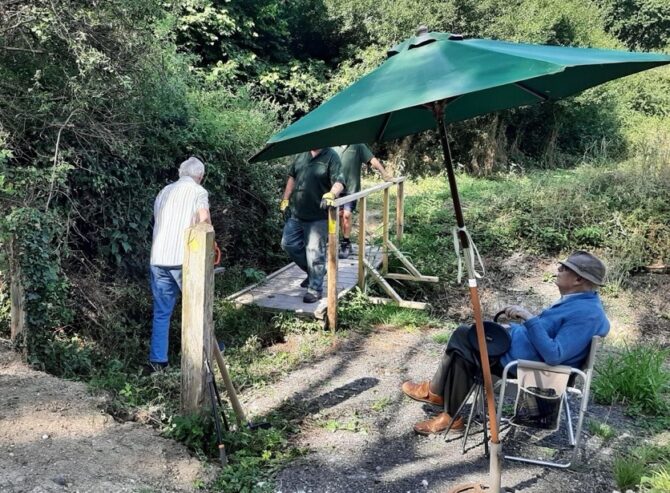
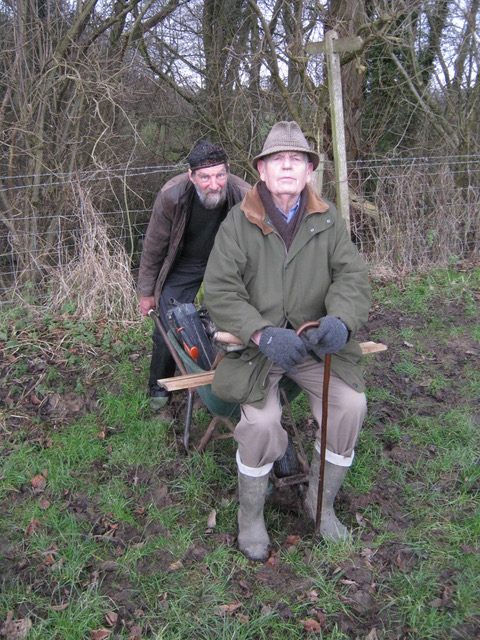
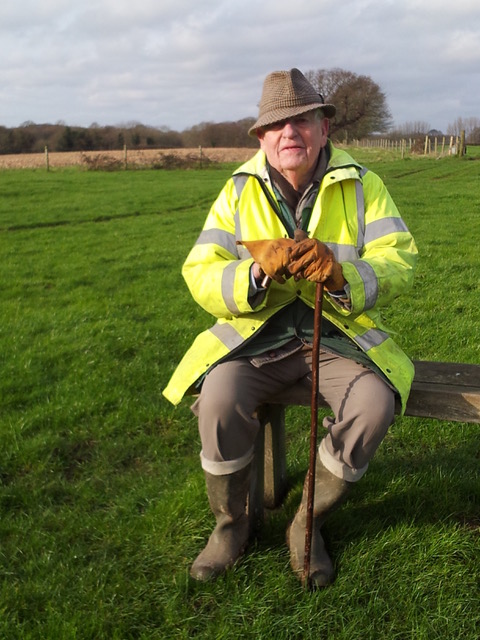
Harold had a ready, dry wit and a wry, often mischievous sense of humour. In his later years, when his role was more supervisory than participatory, he would set himself up on his shooting stick, or chair, and dispense his advice and expertise liberally. Heated discussions often ensued, with as many opinions as volunteers on site. When the work fell below his high standards (he had a particularly uncanny eye for the level) he would revel in calling it out. This may sound mean, but there was always a twinkle in his eye to leaven the chastisement.
Well-being
Harold was also ahead of his time in recognising the social benefits of volunteering, of working as a team in the outdoors, often in challenging conditions and requiring significant physical effort. This is now described as well-being and seen as a significant factor in longevity and delaying the onset of degenerative conditions such as dementia. This is borne out by the age profile of Monday Group members, with centenarians not uncommon (Harold himself lived to 101), and many still volunteering well into their 80s and 90s.
From Beyond The Grave
Harold took pride in turning out every Monday morning come rain, shine or snow, regardless of public holidays, anniversaries, weather warnings or other distractions. On a recent Monday morning, when a storm was raging, our team leader acquiesced to a suggestion that the work should be stood down, commenting that the weather was so bad ‘…we would surely have Harold’s (posthumous) permission to cancel (the) activities.’ Later in the morning, when the storm had passed the team leader was asked what Harold would have said, and the answer was, unequivocally ‘wimps’!
Harold’s Legacy
The Monday Group goes from strength to strength, building on the solid foundations established by Harold and the pioneers. Since his death, the Monday Group has been honoured to receive the King’s Voluntary Service Award in recognition of our service to the community. Harold would have been very proud of this prestigious award, which is surely a testament to his leadership and dedication over the years.
His legacy is the enjoyment of countless walkers over the years (and for many years to come) of the paths the Monday Group continue to make accessible, the moments of wonder and exhilaration enjoyed by many in our beautiful countryside, and the secure future of of our rights of way network, the envy of walkers from far and wide.
Harold’s influence and legacy will be deeply felt for many years.
The Monday Group
November 2023